
Home / Conditions / Ear & hearing
Ear & hearing
Cholesteatoma
Cholesteatoma is a term applied to an invasive process of the middle ear. In essence it is the growth of skin into areas of the ear where it in not usually found.
Clinical content by the surgeons of Sydney ENT Clinic · Updated October 2026
In most cases it is related to long standing eustachian tube dysfunction creating severe negative pressure within the ear.
Once this has developed, the cholesteatoma can cause progressive destruction of the ossicles and thus hearing loss, and more rarely inner ear damage with balance affected, facial nerve damage and finally invasion into the brain.
The usual symptoms are long standing discharge and hearing loss, although it can be essentially symptomatic. Normally there is a long history of ear problems, extending to early childhood.
Once identified surgery is usually required, although the aggressiveness of this disease is variable.
In general terms the aim of treatment is create a safe, dry ear, with attempts to improve hearing an important by secondary consideration.
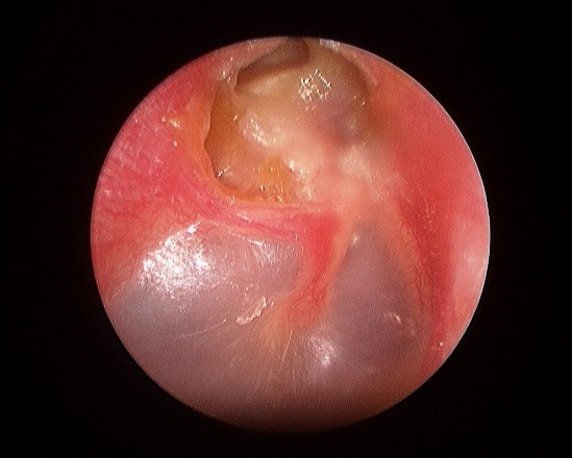
Picture of right ear: destructive process occurring in the attic of the ear.
Tested at Kogarah on the day
Hearing tests with Precision Hearing are available in Suite 5 at the time of your appointment, and CT or MRI of the ear can be arranged at Lumus or Castlereagh Imaging within a few hundred metres of the clinic.
Frequently asked questions
Is cholesteatoma a cancer?
No. Cholesteatoma is not a cancer, but it behaves a little like a benign skin cancer: it grows and invades the structures around it. Because of that it is treated as a surgical condition in most cases — left alone it can cause hearing loss, severe infections, facial nerve palsy and, in extreme cases, meningitis.
Can cholesteatoma be treated without surgery?
In general terms, no. Cholesteatoma is a surgically treatable condition. Drops and antibiotics can settle infection for a time, but they do not remove the growth, and the damage it causes continues while it remains.
What happens if a cholesteatoma is left untreated?
It keeps growing and eroding the structures around it. The consequences are hearing loss, repeated and severe ear infections, facial nerve palsy and, in extreme cases, infection spreading inwards to cause meningitis. This is why it is treated once found.
Will my hearing come back after cholesteatoma surgery?
The first goal of surgery is to remove the cholesteatoma completely and create a safe, dry ear. Hearing is the second goal: in many people it can be stabilised or improved, sometimes with reconstruction of the hearing bones at the same operation or at a later stage, but this depends on how much damage was present before surgery.
Can cholesteatoma come back after surgery?
Yes, although with modern techniques this is uncommon. Cholesteatoma traditionally had a high rate of recurrence, which is why long-term surveillance is needed after surgery — regular examination, and in some cases a planned second-stage operation or an MRI to check that nothing has returned.
Who treats this at Kogarah

Complex otology, cochlear implantation and lateral skull base: Dr Sean Flanagan, Darlinghurst.
For GPs
Send the referral directly to the specialist’s rooms. If the right surgeon isn’t obvious, send it to any of us and we will place it.
Referral information