
Home / Conditions / Ear & hearing
Ear & hearing
Otosclerosis
Otosclerosis is a condition where the stapes (or piston), the last of the 3 middle ear bones, becomes stuck. This prevents transmission of sound into the inner ear and causes a conductive hearing loss.
Clinical content by the surgeons of Sydney ENT Clinic · Updated October 2026
This is a progressive condition, and can affect both ears. This is the result of a very localised abnormality in bone turnover, that does have a familial tendency, and can be exacerbated by pregnancy. It can be unilateral or bilateral, and can often in the later stages also cause nerve damage.
This diagnoses is strongly considered when examination of ear is normal, there has been little in the way of previous ear infections, and with the presence of a conductive hearing loss.
Treatment options come down to the decision between surgery and an hearing aid. The success rates for surgery are high, but are accompanied by a very low risk of worsening the hearing. An extensive discussion is required before making a decision in this regard.
Surgical Treatment
Stapedectomy, or the creation of a small hole through the base of the stapes and insertion of an artificial piston is a very effective way of restoring hearing. The patient however must be counselled that there is an approximately 1% chance of neural hearing damage as the result of surgery.
This surgery is at the challenging end of the spectrum for an otologist. The critical point of surgery is creation of a hole or (stapedotomy) through the base of the stapes. This hole measures only 0.5mm in diameter, and through this a piston is placed. At St Vincent’s Hospital we have the advantage of a KTP laser, which minimises trauma to the inner ear during this step of surgery.
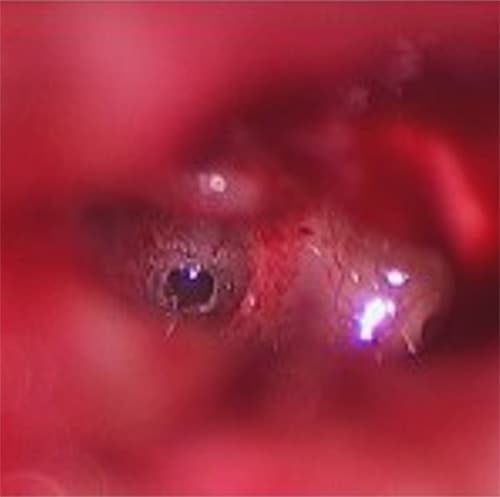
0.5mm stapedotomy through the footplate of the stapes. It is through this hole that the new piston is placed, re-establishing a connection between the middle and inner ear.
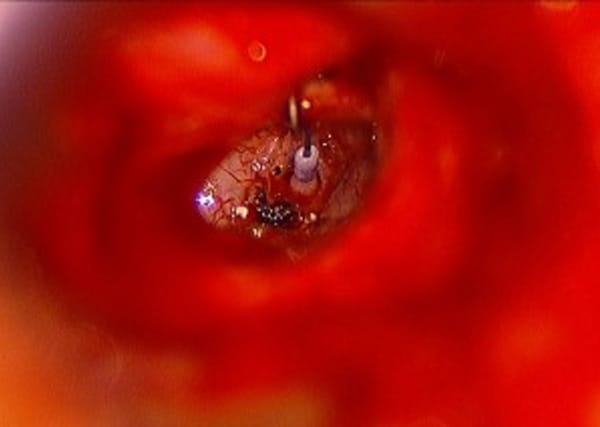
An intra-operative photo of a left ear, where a 0.4mm diameter Nitinol Piston has been inserted through the stapedectomy hole. The laser in then used to fasten (or crimp) the piston onto the incus to allow transmission of sound into the inner ear.
Cochlear Otosclerosis
As mentioned the otosclerotic process can also cause sensorineural hearing loss. Whilst this does not affect the success of surgery in terms of correcting the conductive hearing loss, the expectations in terms of returning the hearing to normal must be tempered.
Tested at Kogarah on the day
Hearing tests with Precision Hearing are available in Suite 5 at the time of your appointment, and CT or MRI of the ear can be arranged at Lumus or Castlereagh Imaging within a few hundred metres of the clinic.
Frequently asked questions
Is otosclerosis hereditary?
Often. About half of people with otosclerosis have a family history of it. It is more common in women, usually first noticed between the twenties and forties, and frequently affects both ears.
What are the options — hearing aid or stapes surgery?
This deserves a detailed discussion with your ENT surgeon, because both are reasonable and the right choice depends on you. A hearing aid is effective and avoids surgery, but must be worn to work — there is no benefit at night or when it is out — and it carries its own day-to-day inconveniences. Stapedotomy corrects the mechanical problem itself: the larger the conductive hearing loss, the greater the potential benefit, and in about 90 per cent of operations the conductive component is closed to within 10 dB of a normal ear. Surgery does not correct any sensorineural (nerve) component, so some people still need a hearing aid afterwards — or need one years later as the nerve component progresses — but an aid works much better once the conductive gap has been closed. The decision is a trade-off between the small risks of surgery and the long-term use of a hearing aid.
How successful is stapedotomy surgery?
Very successful in experienced hands: around 90 per cent of patients achieve hearing within 10 dB of normal for the conductive part of their loss. The risks you need to weigh are a small chance — quoted at about 1 per cent, and probably less — of significant permanent sensorineural hearing loss in the operated ear; smaller risks of altered taste on that side of the tongue and of temporary imbalance; the possibility of the prosthesis failing over time and needing revision surgery; and a standing recommendation not to scuba dive after stapes surgery.
Does otosclerosis get worse with pregnancy?
It is thought to, yes. Pregnancy and the hormonal changes around it are believed to accelerate the conductive hearing loss in some women with otosclerosis. The evidence is less clear-cut than the traditional teaching suggests: a 2022 systematic review of 2,323 women with otosclerosis found that hearing worsened during pregnancy in about one in five, with a correlation between the number of pregnancies and hearing change, but the studies were too varied to draw firm conclusions (Fabbris et al., J Laryngol Otol 2022). Pregnancy is not a reason to avoid treatment, but it is worth having your hearing rechecked afterwards.
Can both ears be operated on?
Yes, but one at a time. The second ear is operated on at least six months after the first, once the result of the first operation is known and the hearing has settled.
Who treats this at Kogarah

Complex otology, cochlear implantation and lateral skull base: Dr Sean Flanagan, Darlinghurst.
For GPs
Send the referral directly to the specialist’s rooms. If the right surgeon isn’t obvious, send it to any of us and we will place it.
Referral information