
Home / Conditions / Ear & hearing
Ear & hearing
Glue ear (otitis media with effusion)
Otitis media with effusion (OME) is the term to describe the presence of fluid within the middle ear, whether it be serous, purulent or mucoid. The commonest synonym is glue ear.
Clinical content by the surgeons of Sydney ENT Clinic · Updated October 2026
In general terms, two thirds of children will be affected by otitis media before the age of 3, with 80% of children before 7 having at least one episode of Acute Otitis Media (AOM). 80% resolve within 7-14 days, and in 80% the effusion has cleared within 3 months. Once an effusion has been present for 3 months, however, only 30% will resolve over the ensuing year.
The underlying pathophysiology of AOM and OME is related to Eustachian tube dysfunction. Anatomical factors in children are a narrow lumen, and a flatter trajectory to the nasopharynx. The presence of adenoid tissue (commonly), or other mass effects placing pressure on the tube are also factors. Functional factors are any that effects nasal mucosa, and thus the Eustachian tube lining. Most commonly this is related to recurrent viral URTIs, but can also be affected by rhinitis. Adenoids, even if small can act as a reservoir for infection and inflammation.
The use of, and timing of insertion of tympanostomy tubes remains controversial. Accurate assessment is difficult and must be conducted by a skilled practitioner. The addition of pneumatic otoscopy is essential, as is audiological testing.
Hearing disability can affect communication, speech, learning and behaviour. In properly selected patients, tympanostomy tubes have been shown to significantly improve language development, reduce the frequency and severity of acute otitis media and reduce the severity of chronic ear disease. Possibly even more importantly they result in a significant improvement in quality of life.
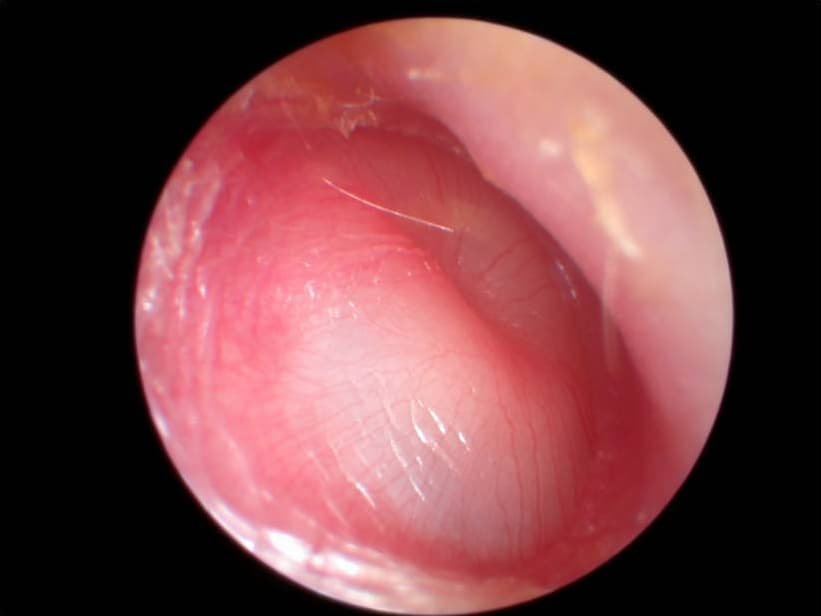
A microscopic view of the right ear. This is the classic appearance of glue ear, with a mucopurulent effusion present behind the drum.
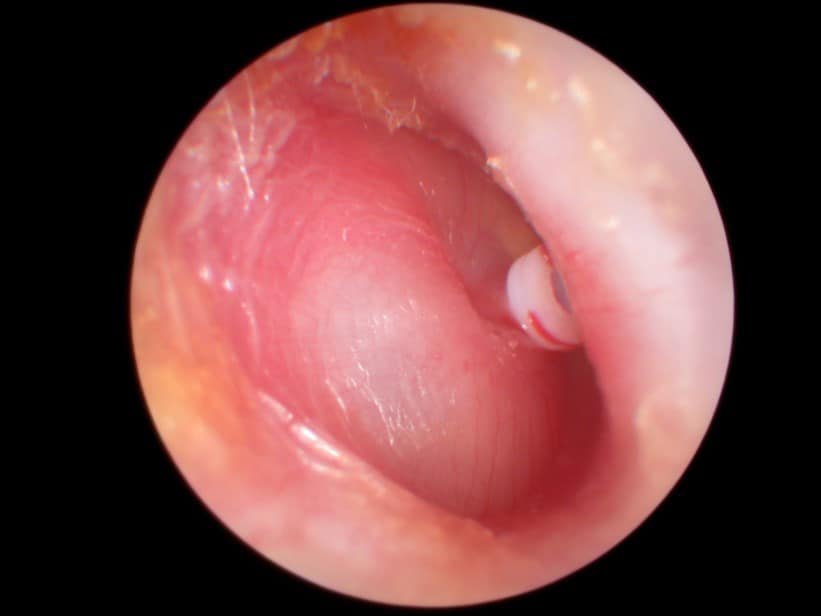
A photo taken immediately following ventilation (grommet) insertion. It is placed into the antero-inferior aspect of the ear drum.
Tested at Kogarah on the day
Hearing tests with Precision Hearing are available in Suite 5 at the time of your appointment, and CT or MRI of the ear can be arranged at Lumus or Castlereagh Imaging within a few hundred metres of the clinic.
Frequently asked questions
Does glue ear go away on its own?
Often, yes — it is very common for children to develop fluid behind the ear drum (a middle ear effusion) after a cold, and most of these clear within weeks. ‘Glue ear’ is the term used when that fluid has become thick and sticky and has been there for more than three months; the thicker the fluid and the longer it has been present, the less likely it is to resolve on its own. First-line treatment is conservative: avoiding and treating upper respiratory infections, nasal saline, a steroid nasal spray, and auto-inflation exercises such as gentle ‘popping’ of the ears or an Otovent balloon device. Only a subset of children need surgery.
How do I know if my child has glue ear?
The main effect is hearing loss, and young children rarely say so. The signs are often subtle: turning the television up, not responding when called, difficulty hearing when there is background noise, tugging or pulling at the ears, a sense of pressure or mild discomfort, or a change in speech development. Confirming it needs a proper examination of the ear drums and an age-appropriate hearing test with tympanometry — both of which can be done on the day at Kogarah.
When does glue ear need grommets?
When fluid has been present in both ears for more than three months, there is a measurable hearing loss, and conservative treatment has failed, grommets should be strongly considered. The three-month mark is the usual threshold, because fluid that has persisted that long rarely clears by itself and the hearing loss starts to matter for speech and learning.
Does glue ear affect speech and learning?
Yes. Hearing matters most for language development from about six months of age, with the peak period between 18 and 24 months — a child with persistent glue ear through this window is hearing the world as if underwater. Persistent hearing loss also affects attention, behaviour and learning at school. This is the main reason persistent glue ear is treated rather than simply watched.
Can adults get glue ear?
Yes. In adults it is usually the result of inflammatory airway disease — chronic sinus disease, allergy or other conditions that affect the lining of the nose and Eustachian tube — and is typically on both sides. Glue ear in only one ear in an adult should always be examined carefully, because it can be the first sign of something blocking that side’s Eustachian tube — a growth in the nasopharynx behind the nose, or disease in the ear itself such as cholesteatoma. That is not usually what is found, but it must be excluded.
Who treats this at Kogarah
 Dr Julia Crawford02 8319 9434
 Dr Greg Shein02 9101 25XX
 Dr Cara Morris02 9101 2525
 Dr Marina Cavada02 9101 2530
 Dr Peta Sacks02 9101 2510
Complex otology, cochlear implantation and lateral skull base: Dr Sean Flanagan, Darlinghurst.
For GPs
Send the referral directly to the specialist’s rooms. If the right surgeon isn’t obvious, send it to any of us and we will place it.
Referral information